
Most building defects do not begin with dramatic failures.
They often start as small and gradual changes that remain invisible for weeks or even months. In timber structures, one of the most important of these changes is moisture accumulation. Elevated moisture content can contribute to mould growth, biological degradation, dimensional instability, and long-term durability issues. By the time visible signs appear, deterioration may already be well underway.
Traditionally, building maintenance has relied heavily on periodic inspections and visual assessments. While these methods remain important, they provide only occasional snapshots of a building's condition. What happens between inspections is often unknown.
With the increasing availability of sensors, continuous monitoring systems, and predictive analytics, a different approach is becoming possible. Instead of waiting for problems to appear, building operators can begin identifying hidden risks through data and understanding how structural components behave over time.
This article presents a timber roof truss monitoring study that explored how environmental data and dynamic modelling can be used to better understand timber moisture behavior and support more proactive maintenance decisions.
From Periodic Inspection to Continuous Monitoring
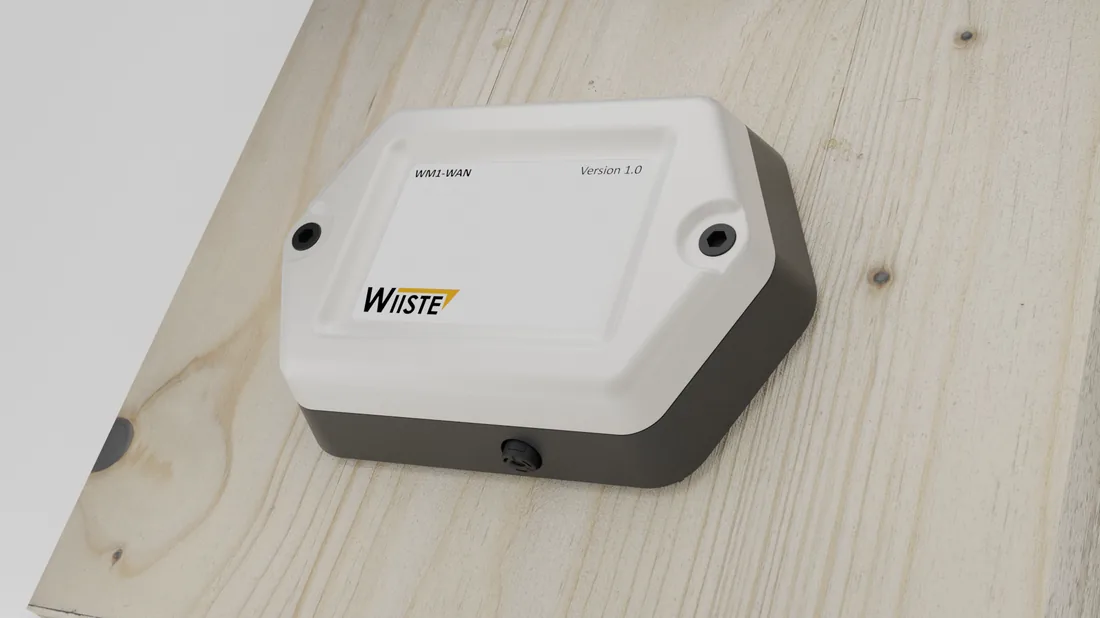
The study focused on a timber roof truss structure equipped with environmental and material monitoring sensors. The objective was to continuously observe how timber moisture content responds to changing climatic conditions within the roof space.
The monitoring system recorded several key variables, including timber moisture content, attic relative humidity, and attic temperature. Over time, this produced a detailed dataset describing both the surrounding environment and the timber's response to it.
The benefit of this approach is straightforward. Instead of relying solely on occasional inspections, building operators gain continuous visibility into how environmental conditions influence structural materials throughout different seasons and weather conditions.
However, collecting data is only the first step. The more important challenge is understanding what that data means and whether it can help predict future conditions.
Can we Predict Timber Moisture Behavior?
A logical starting point was to investigate whether timber moisture content could be explained using current environmental conditions alone. A simple static regression model was developed:
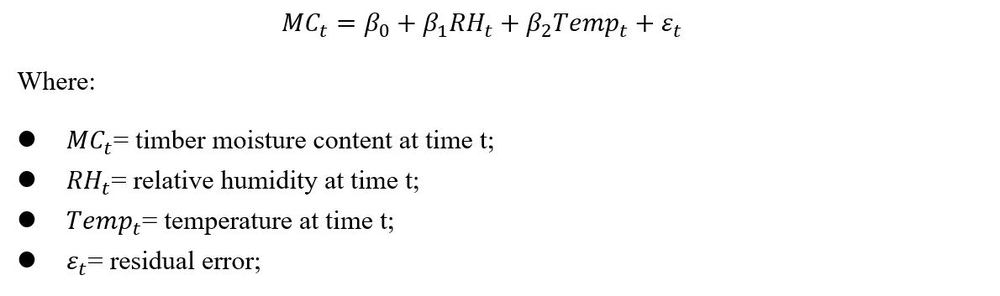
In practical terms, this model assumes that timber responds immediately to the surrounding environment. If relative humidity increases, timber moisture content should increase accordingly. If humidity decreases, moisture content should decrease as well.
This assumption appears reasonable at first. However, the monitoring results suggested that reality is more complicated.
The static model confirmed that relative humidity was an important driver of timber moisture behavior, but the overall explanatory power remained relatively limited. The model achieved an R² value of approximately 0.24, indicating that a large portion of the moisture variation could not be explained by current environmental conditions alone.
This raised an important question: what information was missing?
Why the Static Model Was Not Enough?
The answer lies in the physical behavior of timber itself.
Unlike many mechanical systems, timber does not react instantly to environmental changes. Moisture absorption and moisture release occur gradually. A period of high humidity may continue influencing timber moisture levels long after environmental conditions begin to change.
During the monitoring period, timber moisture content showed strong persistence over time. The material's current condition was heavily influenced by its previous moisture state rather than only by current environmental variables.
In simple terms, timber has memory. Its current condition depends not only on the environment around it, but also on where it was several hours earlier. Once this behavior became apparent, it was clear that a different modelling approach was required.
Introducing the ARX model
To capture this delayed response, a dynamic ARX model was introduced. ARX stands for autoregressive with exogenous inputs. Although the name sounds technical, the concept is relatively straightforward. The model combines two sources of information:
- Current environmental conditions.
- The timber's previous moisture state.
The simplified model can be expressed as:
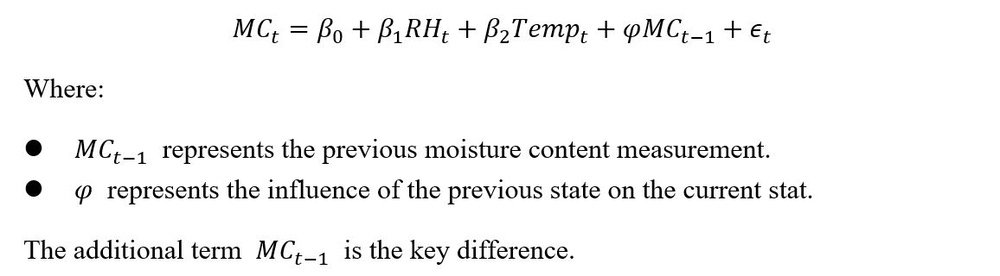
Rather than assuming timber reacts instantly to environmental changes, the ARX model recognizes that moisture behavior develops over time. The previous state contains valuable information about how the material is likely to behave next.
From an engineering perspective, this reflects a simple reality: timber has memory, and predictive models should account for it.
Once the dynamic behavior of timber was incorporated into the model, prediction performance improved significantly. The first-order ARX model already demonstrated substantial improvements compared with the static approach. A second-order ARX model provided an even closer representation of measured timber moisture behavior.
The resulting model achieved an R² value close to 0.999 while maintaining a very low prediction error. More importantly, predicted values closely followed the measurements recorded by the monitoring sensors.
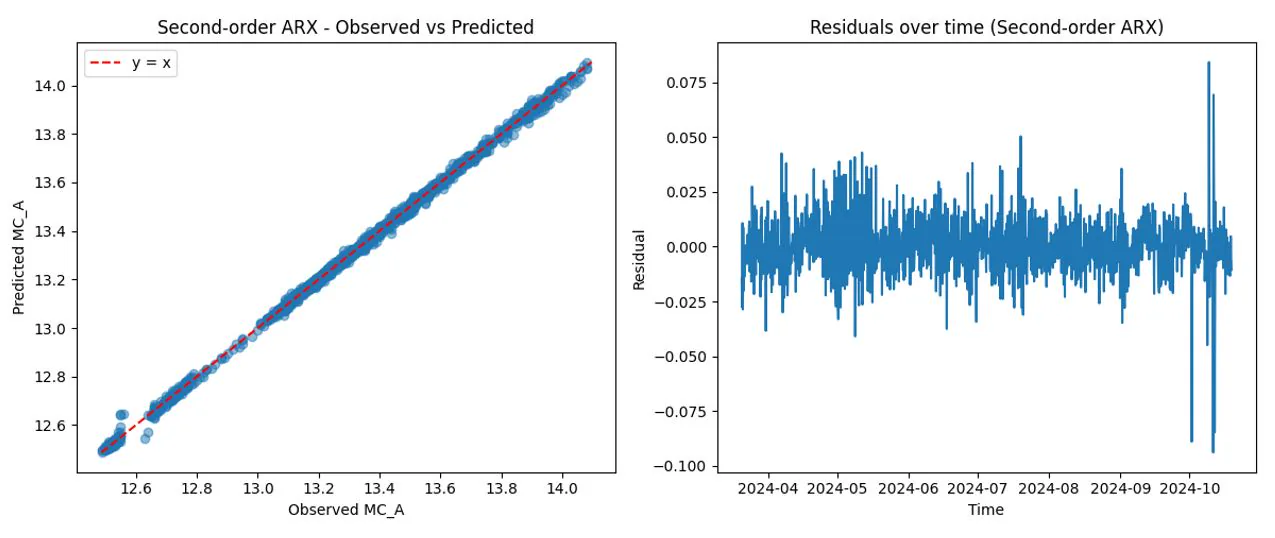
The significance of this result extends beyond statistical performance. A model that can reliably estimate expected moisture behavior provides a baseline for normal operation. Future measurements can be compared against this baseline to identify unusual patterns or emerging risks. Rather than waiting for visible signs of deterioration, building operators gain the opportunity to investigate anomalies at an earlier stage.
The transition is subtle but important. Maintenance shifts from reacting to problems toward anticipating them.
What This Means for Building Maintenance?
The practical value of predictive monitoring is not the model itself. The value lies in better decision-making.
Consider a situation in which moisture behavior begins deviating from expected patterns following an extended period of rainfall. Without monitoring, the issue may remain unnoticed until visible deterioration appears. With continuous monitoring and predictive modelling, unusual behavior can be identified much earlier, allowing maintenance teams to investigate before more significant damage develops.
This approach does not replace engineering judgement or routine inspections. Instead, it helps focus attention where it is needed most. Resources can be allocated more effectively, inspections can become more targeted, and maintenance planning can be informed by evidence rather than assumptions. For building owners and facility managers, this represents a shift toward a more proactive and data-driven maintenance strategy.
It also aligns closely with broader industry goals related to sustainability, resilience, and lifecycle performance. Extending the service life of existing structures is often more sustainable than replacing them, and predictive monitoring offers one pathway toward achieving that objective.
Looking Ahead
While this study focused specifically on timber moisture behavior, the underlying principle is applicable to many other building systems.
Continuous monitoring allows buildings to generate information about their own condition. Predictive models help transform that information into actionable insight.
Future building management systems may integrate monitoring platforms, predictive analytics, and automated inspection technologies to support even earlier identification of potential risks. However, the most important lesson from this project is already clear today.
Buildings contain valuable information about their own health. The challenge is learning how to listen. And that process begins with data.