Germany's construction industry is approaching a turning point.
For decades, Germany has been known for engineering precision, industrial manufacturing, and some of the world's highest construction standards. Yet today, the industry is facing growing pressure from rising costs, labor shortages, demographic change, and increasing demand for faster and more sustainable construction.
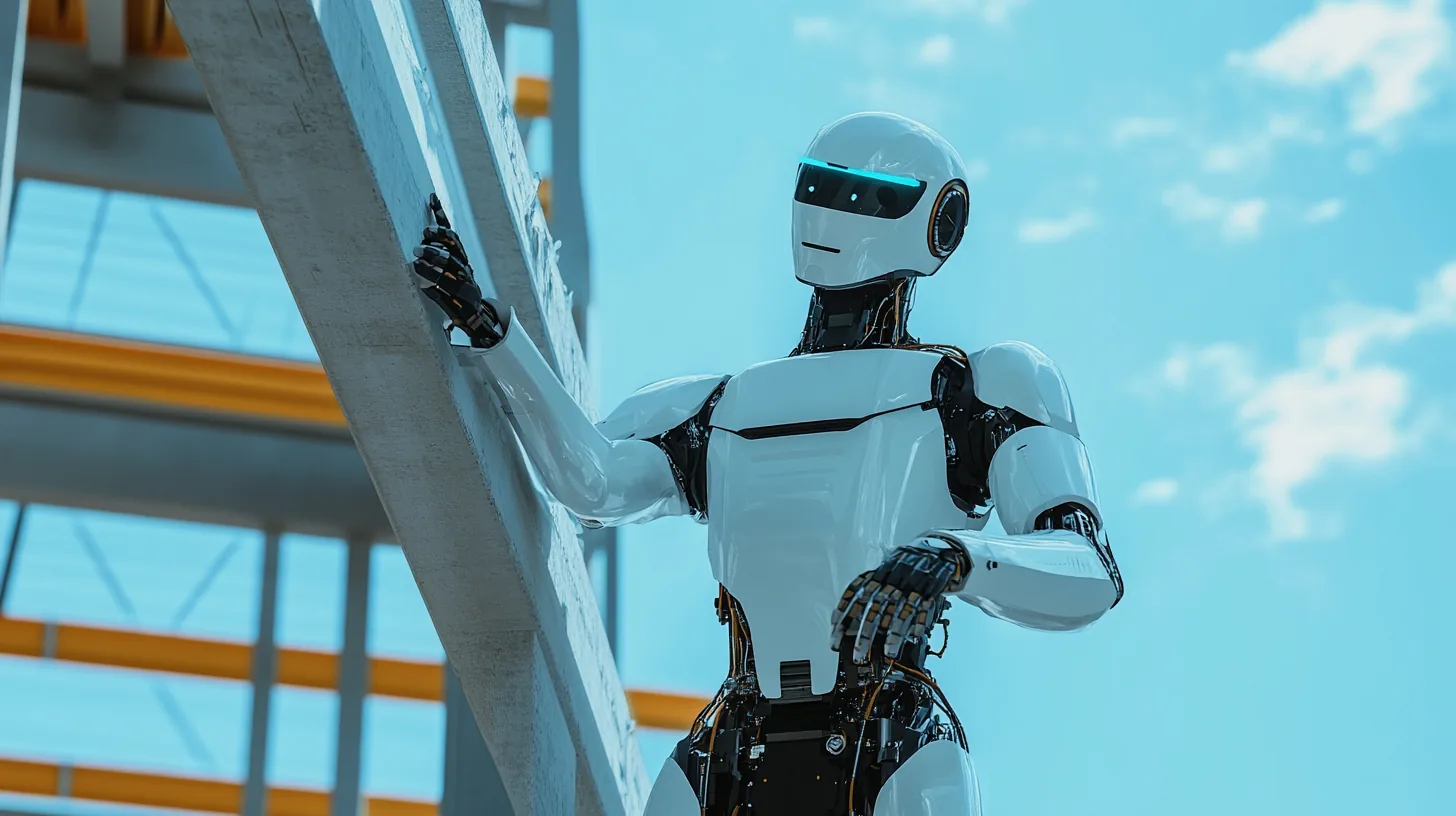
At the same time, artificial intelligence and robotics are evolving at extraordinary speed. Humanoid robots, once seen as futuristic concepts, are beginning to move from laboratories into real industrial environments.
In my view, Germany could become one of the most important markets in Europe for the deployment of humanoid robots in construction over the next decade. And the reason is simple: the industry's current challenges are becoming too large to solve with traditional methods alone.
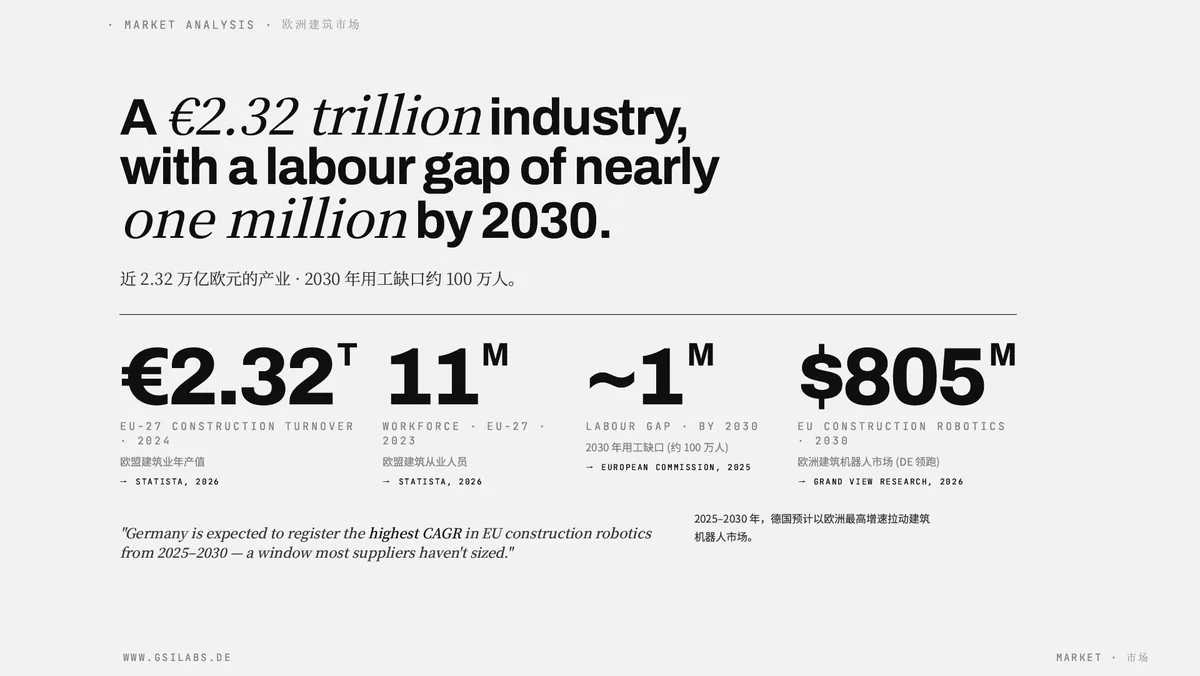
According to Eurostat (2026), the EU construction industry generated approximately €2.32 trillion in annual turnover in 2024, with around 11 million people employed across the sector. By comparison, China's construction sector reached a gross output of around CNY 31.6 trillion (roughly €4 trillion) in 2023 and employed more than 50 million people, illustrating the very different scale and labor structure between the two markets (National Bureau of Statistics of China, 2024). However, Europe is expected to face a labor shortage of nearly one million construction workers by 2030 (William & Harry, 2025). At the same time, Germany is projected to lead Europe in construction robotics growth between 2025 and 2030 (Grand View Horizon, 2026).
This creates a rare convergence of market demand, technological readiness, and operational necessity.
A Sector Under Mounting Pressure
The pressure on the German construction sector is already visible. Infrastructure expansion, renewable energy projects, modular housing, logistics facilities, and especially the rapid growth of data center construction are driving enormous demand across Europe.
At the same time, many companies are struggling to recruit skilled workers for physically demanding and repetitive tasks such as assembly, prefabrication workflows, and high-risk site operations (Deutsche Industrie- und Handelskammer, 2026).
Demographic aging is making the situation even more severe. A large proportion of experienced workers are approaching retirement, while younger generations are becoming less interested in entering physically intensive industries (Statistisches Bundesamt, 2026). The result is rising labor costs, delayed delivery timelines, and increasing pressure on productivity (European Construction Industry Federation, 2026).
Why Humanoid Robots Could Change the Equation
This is where humanoid robots may fundamentally change the equation.
Europe does not simply need more robot prototypes or technology demonstrations. It needs robotic systems that can survive real construction environments, adapt to changing workflows, and operate according to European standards.
Unlike traditional industrial robotic systems that operate in fixed factory environments, humanoid robots are designed for spaces originally built for humans. Construction sites are dynamic and unpredictable: layouts constantly change, materials vary, and workflows shift every day. Humanoid robots have the potential to adapt to these environments with far greater flexibility than conventional automation systems.
In the future, humanoid robots may support material transportation, repetitive assembly tasks, component installation, inspection workflows, and hazardous operations. More importantly, they could allow construction companies to maintain productivity while reducing dependence on increasingly scarce labor resources.
I do not believe the future of construction is humans versus robots. I believe it will become "humans working together with intelligent robotic systems."
Where Deployment Will Begin
The first major deployment opportunities will most likely emerge in industrialized construction environments such as precast factories and modular manufacturing facilities. These environments are already highly process-driven, data-oriented, and increasingly automated, making them ideal transition points for humanoid robotics.
This is particularly relevant for Germany's growing data center market, where speed, standardization, and scalable modular construction are becoming critical competitive factors. Large-scale data center projects require massive amounts of repetitive production, prefabrication, transportation, and assembly work, precisely the type of workflow where robotics can create measurable value.
Hardware Alone Is Not Enough
One of the most important realities in construction robotics is that hardware alone is not enough.
Robots entering the European construction market must adapt to local workflows, BIM systems, German tolerances, safety regulations, and operational standards. This localization layer may ultimately become one of the most important competitive advantages in the industry.
With the support of real European project datasets and operational environments, humanoid robots can gradually move beyond laboratory testing into scalable deployment across construction and manufacturing workflows.
Safety as a Driver of Adoption
Safety may also become one of the strongest drivers of adoption. Construction remains one of the world's highest-risk industries (Gaudiaut, 2026), with workers regularly exposed to heavy machinery, dangerous heights, dust, harsh weather conditions, and physically demanding environments. Humanoid robots could increasingly take over repetitive, dangerous, or high-risk tasks, reducing accident exposure while improving operational consistency.
For Germany, where worker protection standards and regulatory compliance are exceptionally high, this could become a major advantage.
Germany's Industrial Foundation
What makes Germany particularly interesting is that the country already possesses much of the industrial foundation required for this transition. Germany remains a global leader in mechanical engineering, industrial automation, precision manufacturing, industrial software, and sensor technologies. The rise of AI-powered robotics is therefore not starting from zero; it is an evolution of an already advanced industrial ecosystem.
Of course, humanoid robots will not replace the construction industry overnight. Major challenges still exist, including hardware costs, battery limitations, integration complexity, maintenance infrastructure, and strict European regulatory requirements. The adoption process will likely happen gradually, beginning in controlled industrial environments before expanding into broader construction applications.
From Technological Option to Economic Necessity
At the same time, political and institutional support is accelerating across Europe. Germany has already launched initiatives such as the Robotics Research Action Plan to strengthen robotics innovation, industrial competitiveness, and technological sovereignty (Federal Ministry of Research, Technology, and Space, 2026). As labor shortages continue to intensify, robotics may increasingly shift from a technological option to an economic necessity.
The Real Question Ahead
In my view, the question is no longer whether humanoid robots will enter the construction industry. The real question is how quickly companies can integrate AI, robotics, engineering knowledge, and real construction workflows into scalable systems that deliver measurable value.
Germany has the industrial capability, market demand, and engineering culture to become a global leader in this transformation. And the companies that successfully connect robotics with real construction environments will help define the next generation of the European construction industry.